 Courtesy of The Lyric Chamber Music Society of New York, I was able to hear last Wednesday three compositions by the Chinese-American composer Zhou Long (b. 1953). Long’s music had been recommended to me by composer Jeff Nichols, and the Lyric found room for it on an attractive program that opened with Debussy’s Cello Sonata and closed with Mendelssohn’s D minor piano trio. The players were the fearsomely solid Cho-Liang Lin (violin), Hai-Ye Ni (cello), and Helen Huang (piano).Two of Long’s compositions were “early” works from the 1980s: Taiping Drum (for violin and piano) and Wu Kui (for solo piano); the other was a piano trio from 2000 called Spirit of the Chimes. Like most Chinese-American composers, Long is clearly interested in developing a musical language that blends sounds from East and West: Taiping Drum, for instance, appropriates musical material from the “Er Ren Tai” – a song and dance practice from northeast China for two performers. It shouldn’t be a surprise, then, to learn that Long’s music – at least from the evidence of the selections on the Lyric’s concert – is marked by frequent and stark contrasts: the very high rubs shoulder with the very low, the very dissonant with the very consonant, the static with the mercurial.Walking home from the concert, it occurred to me that Chinese-American composers – of whom there’s a bevy right now it seems – haven’t turned up much in discussion on Sequenza21. What do people out there think of Tan Dun, Bright Sheng, Chen Yi (Mrs. Zhou Long, by the way), and Huang Ruo? Any others out there who deserve a higher profile? Naturally they’re composers first and Chinese second, but can their cross-cultural music be said to be initiating a style that can be appropriated by non-Chinese composers?
 Michael Rose, composer and pianist who’s normally found teaching at the Brooklyn Conservatory of Music, has been on a Fulbright-sponsored stay at the Kerala Kalamandalam, a performing-arts school in south India. The nice folks over at the music & audio review site
 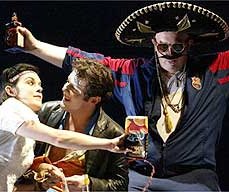 The big news in London this weekend is a £1 million (almost $2m) tie-up between English National Opera and Sony PlayStation to put games consoles into the foyer of the hallowed London Coliseum. This is an opera house renown for its
  Cecilia will tell you:
 Philip Glass turns 70 today and it seems to me he is doing so without much of the hoopla that surrounded Steve Reich’s attainment of that milestone a few months back. No mention of the event in today’s New York Times and Google News turns up only a brief note about a birthday concert in Nashville. Underwhelming reaction for a man who is America’s best-known living composer and one whose music is so widely available in so many forms–CDs, films, concerts and so on.